A pink diamond is one of the rarest things the earth produces. It is also one of the most misunderstood, because "pink" covers an enormous range: from a barely perceptible blush to a colour so saturated it looks lit from within. Here is how pink diamonds are graded, why they are so scarce, and what to look for.
Where the pink comes from
Most coloured diamonds owe their colour to a trace element: nitrogen for yellow, boron for blue. Pink is different. According to the Gemological Institute of America (GIA), scientists believe pink comes from stress. Deep in the earth, the crystal was squeezed and subtly twisted, a process called plastic deformation, which changes how light passes through it. It is, quite literally, a diamond shaped by pressure twice over.
How pink diamonds are graded
GIA grades a coloured diamond's colour by its hue, tone and saturation, then places it on a scale. For pink diamonds the scale runs from Faint to Fancy Deep, with the main grades in between:
- Faint, Very Light and Light: a delicate tint, visible mainly face-down.
- Fancy Light and Fancy: a clear, unmistakable pink.
- Fancy Intense and Fancy Vivid: the strongest and most valuable colours, with rich saturation.
- Fancy Dark and Fancy Deep: deeper tones, where the colour darkens rather than brightens.
A diamond with very strong saturation and enough depth may be graded Fancy Red instead, which is rarer still.
Purity of colour matters
Many pink diamonds carry a secondary colour, and the report will name it: purplish pink, orangy pink, brownish pink. GIA notes that pure pinks are favoured over those with purplish, orangy, brownish or greyish modifiers. When comparing two stones of the same grade, the one described simply as "Pink" will usually command more than its modified counterpart.
The end of Argyle
For almost four decades, the Argyle mine in the remote Kimberley region of Western Australia was the world's great source of pink diamonds. When it closed in November 2020, after 37 years of operation, it had produced more than 90 percent of the world's pink diamonds. No comparable source has replaced it, and the supply of natural pinks has become more limited still. Fine pink diamonds that already exist in the market are, in effect, the supply.
Buying a pink diamond well
- Insist on a GIA report. It confirms the colour grade, any secondary hue, and that the colour is of natural origin.
- Compare stones side by side. Coloured diamonds are graded face-up, as you will see them, and a skilled cut can concentrate colour across the face. Two stones with the same grade can still look quite different.
- Prioritise colour over size. A smaller stone with a stronger, purer grade is usually the more desirable choice.
- Consider the setting. Rose or yellow gold claws around a pink diamond reflect warmth into it; white metal and white diamonds make the colour read more cleanly.
Aurora
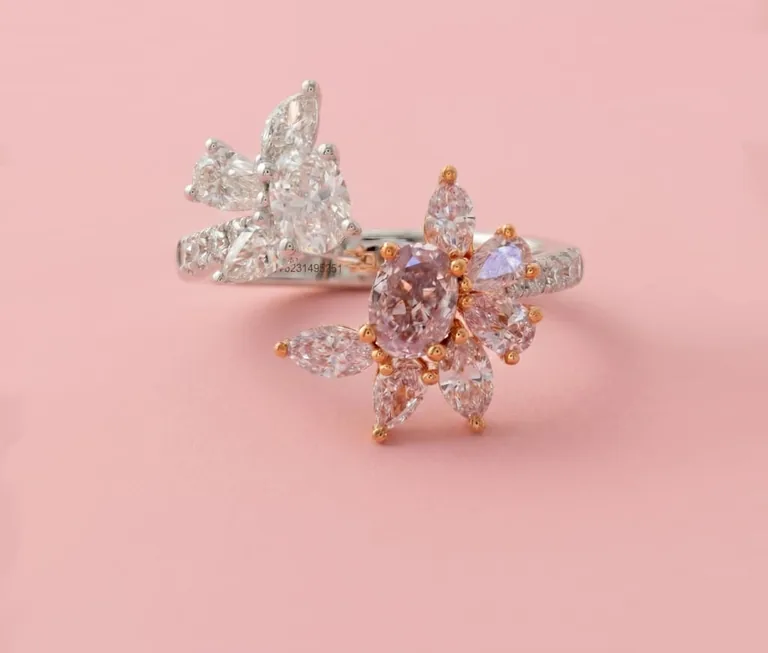
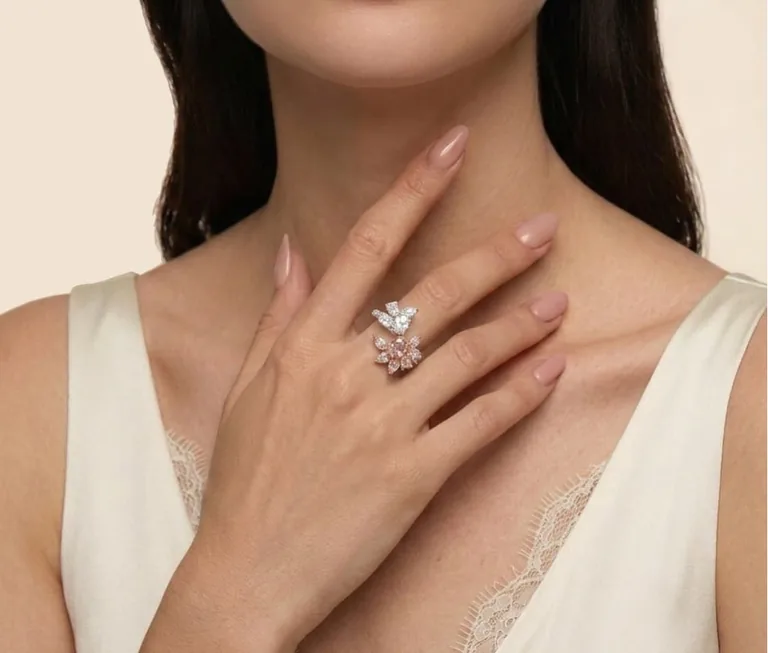
Our Aurora ring was designed around exactly these principles. Its GIA-certified 0.52ct Fancy Pink diamond is held in warm-toned gold, which reflects colour back into the stone, while marquise and pear-shaped white diamonds burst out around it in 18K two-tone gold.
If you are searching for a natural pink diamond, we would be glad to show you certified stones privately. Book a consultation at our Hatton Garden atelier, or explore our full collection.
